1 July 2010

Progress on site, but not on consultation

As it happens, the part of the site where work has begun is visible from a nearby roof terrace, from where the following pictures were taken.


And also . . .


The Environment Agency has appointed someone (call him Mr X) to oversee this development, and he very kindly agreed to tell Tescowatch when work began.  Having heard nothing from Mr X, I therefore sent him the above pictures, and received the following reply :

After the latest activity was reported to me last Thursday, I made several calls to various colleagues expressing my disappointment in not being told about this deposit of waste material, and I am still waiting for a satisfactory answer as to what is going on at the site.  As yet I do not have a direct contact with Tesco, 95% of my information/notification comes from . . . . . at Exminster. He is now awaiting a response from delta-Simons.
I did for my peace of mind visit the site this afternoon at 15:00hrs (no one on site) to check the mound of construct waste your photo shows, interestingly the mound has been levelled off at approximately 2m high.  But still I need to know where this waste material has come from.
Please kept me informed if you see or hear of anything that happens on site that is of a concern to you and I will try to find the answers if I do not know them. Some contactors are not very good at communicating with the Agency and some individuals within the Agency do not always remember to pass the relevant information down to the person on the ground.
So, for whatever reason, the Environment Agency officer is being kept in the dark: what chance does the community have ?  And what does this tell us about Tesco's attitude to anyone else but their shareholders ?

The Tesco leaflet

Some people got leaflets, and others did not.  I hope Tesco will not object if I publish material taken from their leaflet - without modification - so that more of us can see what they have to say.

Page 2 tells us about the infill source . . .


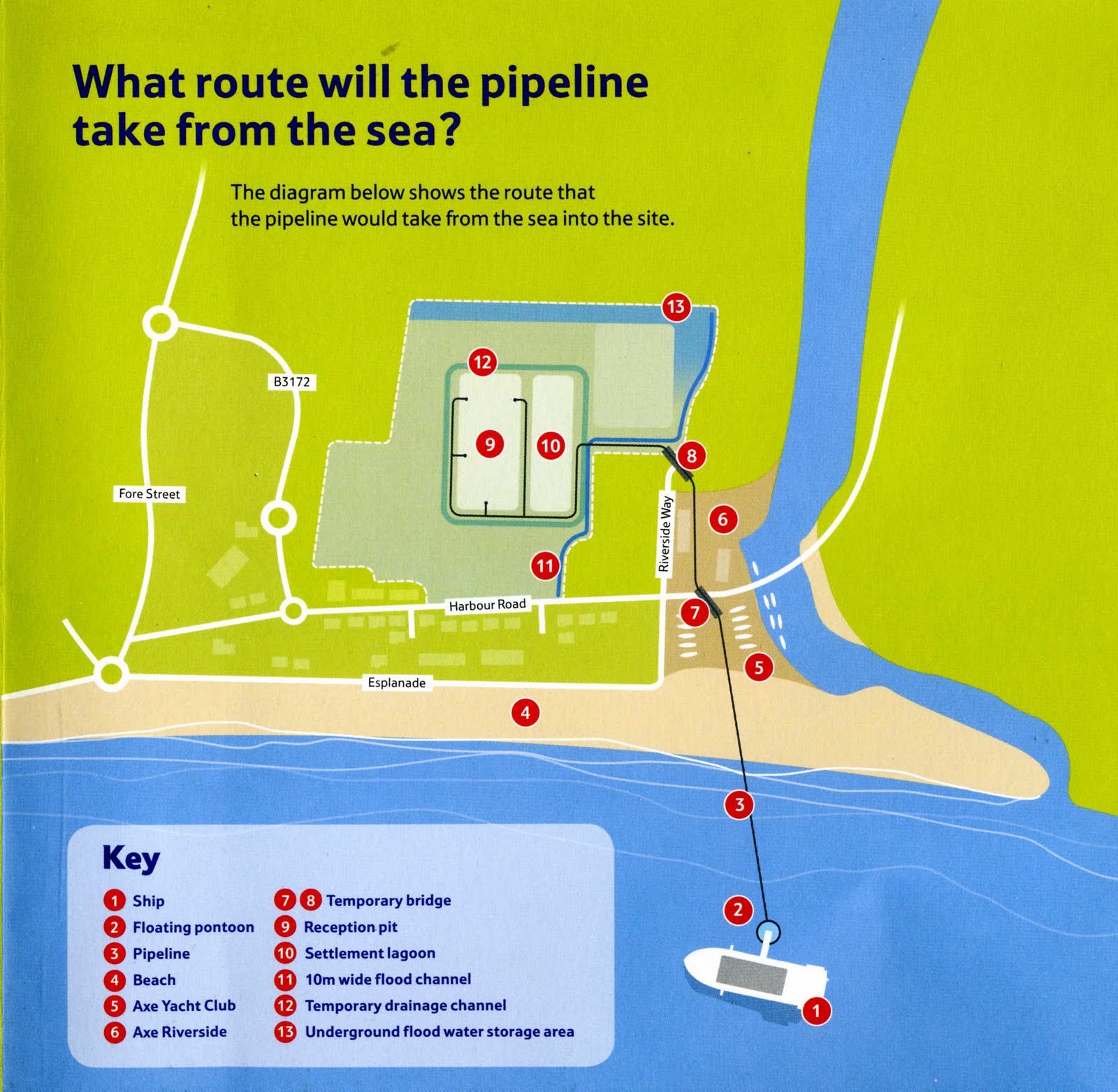
Then there is a new diagram of the infill site . . .


This needs a little study; however one point is worth emphasising. Item 11 is the new flood relief channel, which appears for the first time, and only after Tescowatch complained about it's absence.  Tescowatch has thus made a major contribution to the safety and viability of the project; so, can we expect a Tesco hamper for our efforts ?

The other processes are easier to follow after looking at the next page . . .


Stage 5 is interesting.  What exactly are they testing the water for ?  Presumably to see if all the sediment has settled out in stage 4.  If not, they can wait a little longer.  But what about the toxic metals ? 

The Environmental Health Officer has determined that the site is contaminated with Chromium and other poisonous materials soluble in water.  How much of this will be collected by the seawater which is going back into the bay ?  It is all very well waiting for sediment to settle: it will do this all by itself (unless there is a lot of clay); but toxic metals in solution do not go away with time: they can only be removed by complex and expensive chemical processes, and I don't see any provision for these.  They do not even seem to be testing for toxins, let alone treating them.

Another point arises about the Axe estuary, which is a Special Conservation Area.  The site is in hydraulic continuity with this estuary and marshes - which means that water from the site can seep into the river and the marshes through the porous silt.  If they pour millions of gallons of sea-water onto the site, how much of the toxic metal will be flushed into the estuary ?  I don't know, and nor does Tesco . . . but they should be finding out.  What about it, guys ?

9 June 2010

Work starts on the ziggurat - and some Tesco leaflets

Our observers report that a small hole was dug on the regeneration site today - presumably to begin the construction of the settlement test structure approved by 09/2337/FUL - which we call the ziggurat.

To be sure, this is not very exciting news to the world at large, but to us Tescowatchers (who have had nothing to watch for months) it is the first sally in what we expect to be a major campaign. 

And there is more news.  The residents of KIngs Court, which is adjacent to the Tesco site, complained about Tesco ivy growing on their fence.  They were told that steps would be taken to remove the ivy tomorrow (Thursday10th June). 

On the same day (Thursday), Tesco staff would distribute leaflets at various points throughout the town. Make sure you get your copy and tell them what you think about their project.

30 May 2010

What's going on ?

At the General Meeting of the Development Trust last week someone asked me what was happening about Tesco, as they had not heard anything for ages.  I had to say that, aside from on-site soil sampling, I had heard of nothing.

Since then, I have heard a rumour that Tesco's next planning application was submitted to East Devon District Council last Thursday  . . . by co-incidence, the very day of the Trust General Meeting. 

Any application would  need to be validated before appearing on the EDDC website, so we would need to wait some days at least before any hard information is available.

Watch this space

6 May 2010

Tesco in Seaton hits the National Press

While having no direct connection to TescowatchSeaton, it should be of interest to all Tescowatchers to have a look at Wednesday's Guardian. The Society supplement had on page 1 a large picture of the Mayor of Seaton looking more than usually pugnacious and talking good sense about the impact of Tesco on her town

For those non-Guardian readers, the article can be seen here

11 April 2010

Letter to the press about new flood hazard

Here is the letter I sent . . .

I have sent you a copy of our email to Stephen Belli about this new flooding hazard for Seaton.  I am now sending you the supporting diagrams and explanatory argument.   Much of this is discussed on our blog at http://www.tescowatchseaton.blogspot.com/, but this had no pictures and these are essential to understanding our concerns.


Look at T1 above  This is taken from the sucessful Tesco planning application and shows the overall layout of the whole regeneration site.  Important here is the role of the flood relief channel, which I have marked.  


This runs from Harbour Road at the bottom of the picture (south) to the marshes at the top (north).  Harbour Road is the lowest part of Seaton and most susceptible to flooding from the sea or river.  This danger is greatly increased by raising the regeneration site and so stopping flood water draining north to the marsh.  To reduce this danger, the Tesco plan provides a flood relief channel (also called a monsoon drain or berm) running north-south right through the development site at low level, so cutting the site into two halves.

When the site is raised and a flood comes, water can flow from Harbour Road to the marshes along this channel.  Without the channel, raising the site means a serious increase in the flood risk for the whole area, which is largely residential.  We were not terribly happy about this solution, but it is better than nothing.


Now look at T2.  This shows Tesco's proposal to raise the whole site by pumping in infill from the sea.  The idea is to build a high wall right round the site, pump in a mix of seawater and aggregate along the black pipeline grid, allow it to settle, collect the seawater in a lagoon (blue arrows) and then pump it back out to sea.

The flood relief channel (FRC) is visible (and dotted by me), along with all the later buildings, so they seem to have just pasted their proposals on top of an earlier version of T1 without paying attention to the details.  They clearly have no understanding of the function of the FRC, as both the black pipeline and the blue water arrows flow straight over it, and it will be filled up with the rest of the site.  Without the FRC, the only flood protection device is lost and the whole area is at enormously greater risk of flooding.

We complained about this to the Environment Agency.  The correspondence is covered in the blog but, basically, they said leave it to the Tesco engineers.  But we can see no economic solution, and after 5 weeks, nor (it seems) can they.

Consider the options.

1.  Fill the site in two halves, on either side of the FRC.  This will require two separate filling operations, with separate piping and drainage lagoons.  It might be possible, but it is going to be very slow and very much more expensive.

2.  Fill the whole site and then dig out a new FRC.  This has two objections.

  • While the site is being filled, there is no FRC.  If a flood comes along during the filling process, Harbour Road has no protection.
  • Digging a channel through slippery sediment deposited from seawater is not going to be easy - and may be actually impossible.
There is no official acknowledgement of these problems, nor of the hazard to Seaton.  The Tesco contractors have made mistakes in the past (see the blog) and we are worried that they may be about to make another one - with potentially catastrophic results.

 We want EDDC and the EA openly to acknowledge the problem and tell us how they propose to deal with it.  Under these circumstances, we can only appeal to the power of the press and public opinion to bring this about.

3 April 2010

No satisfaction yet on wall safety and flooding hazard

On 8th March (see below) we flagged up a new flood hazard presented by the Tesco scheme, and wrote to the Environment Agency on 9th March for their reaction.  In addition, we asked about the safety of the high temporary walls to be built around the site.  For several weeks there was silence - presumably while the EA consulted the Tesco consultants.  Then, on 25th March, we received their reply.

On the issue of the wall safety they say . . . "The use of hydraulic fill is a well established civil engineering technique and has been used to fill dams and move aggregates and minerals for many years. We are currently unaware of any examples where this technique has been used to fill prospective development sites in the manner being suggested in Seaton.  You may wish to search the internet for examples as they may exist.  However, we cannot rule this technique out as a possible solution to the raising the site in an efficient and timely manner.   Civil liability would rest firmly with the consultants/contractors in the event of any problems occurring.

The integrity of any temporary impounding banks is largely a matter for the consulting engineers, to satisfy themselves upon as part of any overall scheme design.  We must wait to consider any proposal that Jubbs wish to promote but shall at all times seek to protect the local environment and ensure as far as we are able that any proposal is safe.  "


To summarise the reply on wall safety. . .
  1. This site infill method is unknown to them
  2. If anything goes wrong, sue Tesco
  3. It is up to the consultants (Jubbs) to decide on the quality of their own work
  4. The EA will ensure safety as far as they are able, but no further.
Now, Jubbs are a well-known firm of engineering consultants who advised Liatris, the previous potential developers of this site.  However, anyone can make a mistake, and we were able to find a serious flaw in their flood risk analysis for Liatris.  By using an outdated version of our old friend PPS25, they proposed a much smaller (hence cheaper) infill volume than was actually required by law.  This was not noticed by the EA, nor by EDDC . . . it was left to our small team of amateurs to detect and correct it.  Our correction was then enforced without explanation or apology.

Now we are looking at a much more ambitious procedure - totally new and untried on this kind of site (says the EA). Who is to say that Jubb may not make another mistake - as they did before?  Who is going to be checking their work ?  Only the EA, as far as they are able; and how far is that ?  Judging from past performance, and the letter above - not very far at all.

Tescowatch will do it's best; but without access to the site or professional advice we may miss something.  It would be far better for the regulating authority (EA) to take on this role with committment and enthusiasm on behalf of us all - as is their function.

As far as flood protection during construction is concerned, the EA reply says . . . " Separate drainage proposals would need to be agreed prior to the main body of work proceeding. Consideration would have to be given to adverse weather, impact on watercourses and potential impact on groundwater.  We understand Jubbs have been considering a number of options to fill the site so we do not wish to speculate upon which, if any, might meet with our approval. "

This sounds reasonable enough (if rather vague), except for the fact that several site plans have already been tabled by Tesco - and approved by the EA - which show no flood protection at all during the infill phase.  Why was this problem not raised by the EA at that stage ?  Why did it have to wait for us amateurs to query it ?

No-one doubts the expertise available to the EA. Why won't they use it ?